- Mon-Sun : 9.00 AM - 5.00 PM
Phone Number
+971 52 860 5588
Send Your Mail
husnain.abdulrasheed786@gmail.com

“Your AC could be struggling for several reasons — some obvious, some hidden inside the unit. Below are the six most common causes we diagnose in Dubai homes, from dirty filters to refrigerant leaks. Tap on any cause to see the full explanation and fix.”
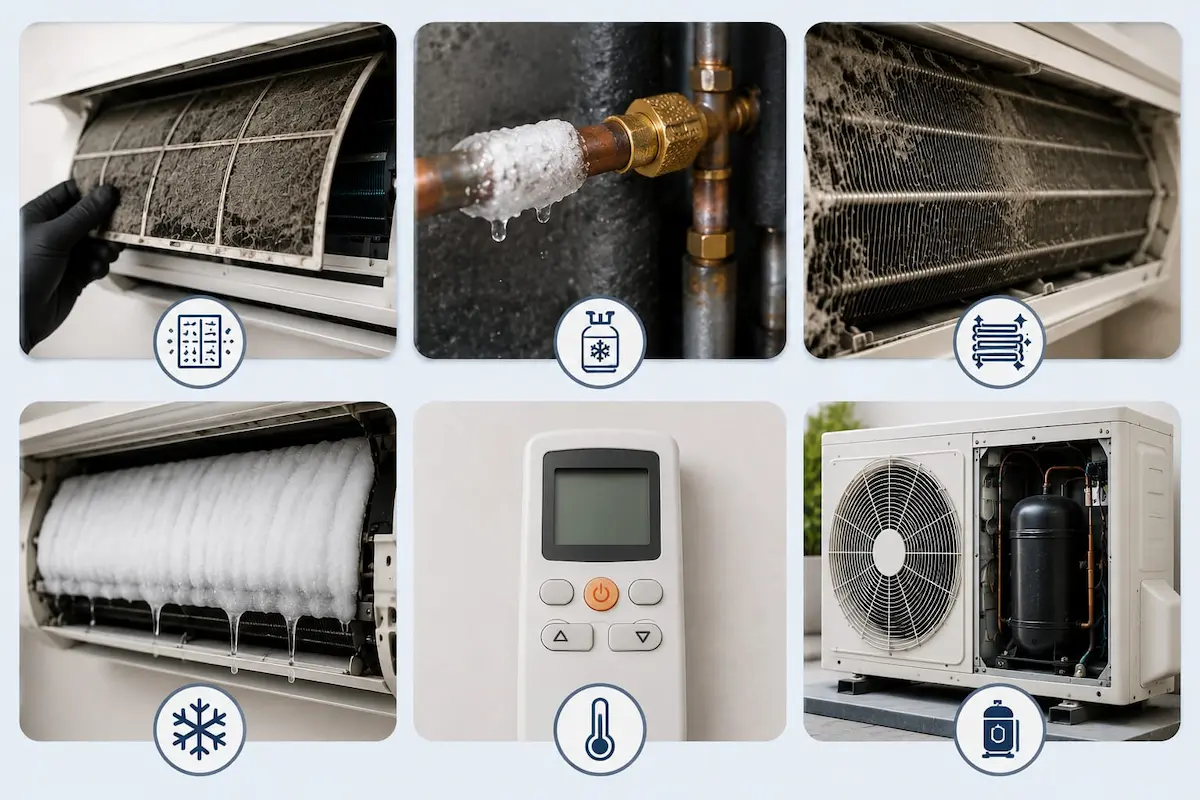
Most guides give you the same five causes copied from a global HVAC template. Some of those causes are valid anywhere in the world. But Dubai has specific environmental factors that change both the frequency and the order of priority. Here is what is most likely causing your AC problem — ranked by how commonly we see each fault in Dubai properties.
This is the number one cause of poor AC cooling in Dubai — by a significant margin. In most countries, AC filters need cleaning every one to three months. In Dubai, during sandstorm season or in apartments near construction, that window can shrink to two to four weeks.
When a filter is blocked, airflow through the unit drops dramatically. The evaporator coil cannot absorb heat properly because not enough warm room air is passing over it. The result: the air coming out feels weak, barely cool, or in serious cases, warm.
| Quick check: Locate your filter… (usually behind the indoor unit grille or inside a return air vent). Remove it. If you can’t see light through it when held up to a window, it needs cleaning now — not next week. A clogged filter also forces your compressor to work harder, which accelerates wear and increases your DEWA bill. |
The fix is straightforward: clean the filter with warm water, let it dry completely, and reinsert it. If the filter is damaged or has not been cleaned in over six months, replace it. Filters for most split AC units in Dubai cost AED 20 to AED 80 depending on the brand.
Important: if you clean the filter and the AC still fails to cool within 30 minutes of restarting, the blockage has caused a secondary fault — almost certainly a frozen or coil problem. Read on.
Cleaned the filter but still no cooling? That usually means a deeper fault.
Message us on WhatsApp →
Refrigerant — what most Dubai residents call “AC gas” — is the substance that makes cooling physically possible. It absorbs heat from the air inside your home and releases it outside through the condenser unit. Without sufficient refrigerant, this heat exchange cannot happen properly, and you get warm or barely cool air from a running unit.
Here is the critical point that most guides get wrong: refrigerant does not simply run out over time like petrol. A properly sealed AC system should hold the same refrigerant charge for its entire lifespan. If your gas is low, it means there is a leak somewhere in the system. Simply topping up the refrigerant without finding and sealing the leak is a temporary fix that will fail again within weeks or months — and adds unnecessary cost.
| Signs of a refrigerant leak: ice forming on the copper pipes coming out of your indoor unit, a hissing sound near the unit, the AC cycling on and off frequently, or a significant drop in cooling performance that appeared suddenly rather than gradually. If you notice ice forming, turn the AC off immediately and run only the fan for 2 hours to allow the coil to defrost before calling a technician. |
A proper gas refill in Dubai starts from AED 200 per unit, and should always include a leak check and seal. Any company offering a gas top-up without inspecting for the leak source first is not doing the job correctly
Inside your indoor AC unit sits the evaporator coil — a series of metal fins and tubes through which refrigerant flows. As warm room air passes over this coil, heat transfers from the air into the refrigerant, and you get cooled air out. When the coil is coated in dust, sand, and debris — which happens in Dubai far faster than the global average — this heat exchange is severely reduced.
A dirty evaporator coil does not always produce obvious symptoms on its own. You might notice the AC seems to be working harder than usual, that cooling takes longer than it used to, or that the air coming out is not as cold as it should be for the temperature setting you have chosen. Energy consumption goes up as the unit compensates.
Dubai’s fine desert sand is particularly problematic for evaporator coils because the particles are small enough to bypass moderately blocked filters and coat the coil fins directly. This is why professional AC servicing in Dubai — which includes a proper coil clean, not just filter washing — is recommended more frequently than the global standard.
A deep coil clean starts from AED 249 in Dubai and should be part of your annual or bi-annual AC service schedule.
This one surprises many Dubai residents. Ice forming on your AC unit in 45°C heat sounds impossible — but it is one of the more common AC faults in the UAE, and it usually develops as a consequence of one of the causes already listed above.
When airflow is restricted (blocked filter) or refrigerant is low, the evaporator coil temperature drops below freezing. Moisture in the air condenses on the coil and freezes into ice. The ice layer then acts as an insulator, further reducing the coil’s ability to absorb heat, and you end up with an AC that is running at full power but producing almost no cooling at all.
| What to do if your AC coil is frozen: Turn the unit off completely — do not just switch to fan-only mode if ice is visibly present on the pipes. Leave it off for at least 2 hours to allow full defrost. Place towels near the indoor unit to catch drips as the ice melts. Then clean the filter. If the unit re-freezes after restarting, call a technician — the underlying cause (low gas or airflow restriction) needs professional attention. |
Before assuming the worst, check the obvious. A faulty thermostat — or a thermostat with a drained battery — can cause the AC compressor to stop engaging while the fan continues to run. The result is air coming out at room temperature rather than cooled air, which feels like a cooling failure but is actually a control failure.
Check the controller batteries first. Then check that the thermostat is set to COOL mode, not just FAN mode. Some Dubai apartment AC systems, particularly older Carrier and York central systems, have a thermostat sensor that can drift and give incorrect temperature readings — causing the system to believe the room is already at the target temperature and shutting off cooling as a result.
Thermostat replacement in Dubai starts from AED 120 for standard units. Smart thermostat upgrades from AED 250. If your system is diagnosed as a thermostat issue, this is the most cost-effective repair on this list.
The compressor is the heart of the AC system — it pressurises the refrigerant and drives the entire cooling cycle. When it fails, the system cannot cool at all. You will typically hear the outdoor unit running (the fan is spinning) but producing no cooling whatsoever indoors. Sometimes the outdoor unit will not start at all.
Compressor failure is the most expensive AC fault and the one most likely to prompt a landlord-tenant dispute about who pays. We will address this directly in the RERA section below.
Important: do not assume compressor failure before a proper diagnosis. A tripped capacitor — a component that starts the compressor motor — can produce identical symptoms and costs AED 150 to AED 250 to replace, compared to AED 800 to AED 2,500 or more for a compressor. Always get a diagnosis before approving a compressor replacement.
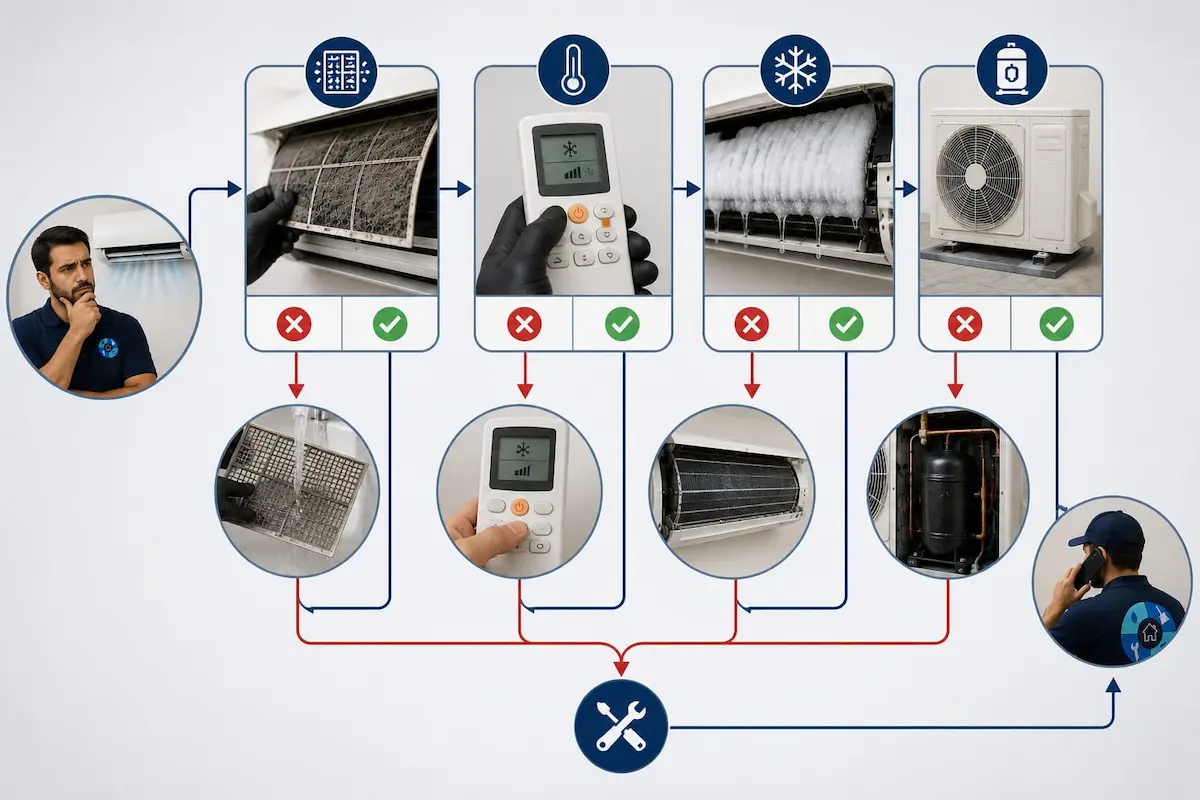
Use the table below to narrow down the most probable cause before calling a technician. This does not replace a professional diagnosis, but it can save you time and help you have a more informed conversation when you call.
| What you observe | Most likely cause | What to do first |
| AC running, fan blowing, air barely cool or warm | Blocked filter (80% probability in Dubai) | Clean or replace the filter. Wait 30 min and reassess. |
| Ice visible on copper pipes outside indoor unit | Frozen coil from low gas or blocked filter | Turn unit OFF completely. Defrost 2 hours. Clean filter. Call technician. |
| AC cools for 20 min then stops cooling | Thermostat or sensor fault / frozen coil cycling | Check thermostat batteries and settings. Note if ice is forming. |
| Hissing sound near indoor unit + poor cooling | Refrigerant (gas) leak | Do not top up gas without leak test. Call technician. |
| Outdoor unit fan running, zero cooling indoors | Compressor or capacitor fault | Turn off and call technician. Do not run a faulty compressor. |
| Weak airflow from all vents + warm air | Dirty evaporator coil / blocked ducts | Book a professional coil clean. Do not confuse with filter issue. |
| AC works fine, one room stays warm | Duct issue / undersized unit for that room | Check duct connection to that room. Not a system fault. |
| New AC install or after moving in — never cooled well | Undersized unit / installation fault / gas undercharge | Request a load calculation and installation review. |
“Matched your symptoms above? Get a same-day diagnosis before the fault gets worse.Request one on WhatsApp →
This is the section nobody else has written — and the one that will save some of you a significant amount of money.
Every year, thousands of Dubai tenants pay for AC repairs that their landlord was legally obligated to fund. They pay because they did not know their rights, because their tenancy contract contained a clause that seemed to assign responsibility to them, or because their landlord confidently told them it was their problem. In many of these cases, the law was on the tenant’s side.
Here is what Dubai Law No. 26 of 2007 and RERA’s maintenance framework actually say.
The foundation of maintenance law in Dubai is Article 16 of Law No. 26 of 2007, also known as the Dubai Tenancy Law. It is direct:
| “The landlord must maintain the property in a condition suitable for its intended purpose throughout the tenancy — including conducting all repairs and addressing any defects or damage that prevents the tenant from fully using the leased property.” — Dubai Law No. 26 of 2007, Article 16 |
Notice two things about this law. First, it is a continuing obligation — not a one-time responsibility at the start of a lease. The landlord must maintain the property throughout the entire tenancy period. Second, it specifically covers defects that prevent the tenant from fully using the property.
In Dubai, where temperatures regularly exceed 45°C from June through September, a non-functioning AC system does not merely reduce comfort — it makes the property effectively uninhabitable. This is not a legal technicality; it is explicitly supported by RERA’s interpretation of habitability in the UAE climate context.
Source: Dubai Law No. 26 of 2007 | Bayut.com RERA Tenancy Law Guide 2026 | LetsFixIt.ae Building Maintenance in UAE 2026
Under Article 16 and its 2026 clarifications, the landlord is legally responsible for:
| Important 2026 update: A new rental law clarification published in May 2026 explicitly states that major appliance replacement — including HVAC systems and water heaters — is the landlord’s responsibility unless the tenancy contract states otherwise AND the tenant agreed to this arrangement in writing at the time of signing. A clause buried in a standard tenancy contract that the tenant was not specifically advised of may not be enforceable. Source: realestateclubdubai.com, New Rental Laws Dubai 2026 |
The Dubai tenancy framework does assign some maintenance responsibilities to tenants — specifically for minor repairs and day-to-day upkeep. In the context of AC systems, this typically means:
The threshold repair values above (AED 500 for apartments, AED 1,000 for villas) come from common RERA practice, not from a single specific law article — and they apply only where the tenancy contract explicitly assigns minor repairs to the tenant. If your contract does not contain this clause, even minor AC repairs may fall to the landlord.
Source: Bayut.com RERA Tenancy Laws | Kaizen Asset Management, Landlord vs. Tenant Maintenance Responsibilities Dubai 2026
| Scenario | Who pays legally | What the law says |
| Compressor fails in a 5-year-old AC unit | Landlord | Major mechanical failure. Article 16. Age of equipment is not a valid basis for shifting cost to tenant. |
| AC not cooling because tenant never cleaned the filter — coil has frozen and damaged the compressor | Tenant (potentially) | Tenant’s failure to perform routine upkeep (filter cleaning) caused the fault. However, this must be proven — the landlord cannot simply claim this without evidence. |
| Gas (refrigerant) leak causing poor cooling | Landlord | This is a system defect, not tenant-caused damage under normal circumstances. |
| AC works but tenant wants a newer or more powerful unit | Tenant pays for upgrade if they want it | The existing unit is functional. Landlord’s obligation is to maintain what is there, not upgrade it. |
| AC breakdown in an apartment that was already faulty when tenant moved in | Landlord | Pre-existing fault. Tenant should document condition at move-in. Landlord responsible regardless. |
| Tenant damaged AC unit by tampering, blocking, or operating incorrectly | Tenant | Tenant-caused damage is the tenant’s responsibility. Landlord can deduct from security deposit. |
If your AC is not cooling and your landlord is not responding or is denying responsibility, here is the correct escalation path under Dubai law:
| Dubai’s Rental Disputes Centre now handles complaints entirely online. Tenants and landlords can file, upload documents, and attend hearings remotely. Most standard maintenance cases are resolved within 1–2 weeks. Access the RDC portal at rdc.dubai.gov.ae |
Source: ahli-law.com, Dubai Key Tenant Rights 2026 | realestateclubdubai.com, Complete Tenant Rights Guide Dubai 2026
RERA’s framework is clear in principle but messy in practice. Here are the scenarios where responsibility is genuinely contested and where the outcome depends on documentation, contract wording, and evidence.
This is the most common grey area we encounter. The landlord claims the AC failed because the tenant never cleaned the filters. The tenant claims the unit was already underperforming. Neither party has documentation.
The legal principle: if the tenant’s neglect of routine maintenance (specifically, failure to clean filters) caused or significantly contributed to a more serious fault (coil damage, compressor stress), a court or the RDC may apportion some responsibility to the tenant. But the landlord must prove the causal link — and “the filters were dirty” alone is rarely sufficient without a professional assessment confirming it caused the fault.
How to protect yourself as a tenant: Clean your AC filters every 4 to 6 weeks during summer, or after every sandstorm. Keep a simple log — a phone photo with date each time you clean. If you have never cleaned them since moving in, start now.
A very common landlord tactic: the AC is beyond repair and needs replacing, which costs more than the repair threshold, so the landlord wants to split the cost or delay action.
The 2026 legal position is clear on this point. As explicitly stated in the updated UAE maintenance guidance: a landlord cannot legally require a tenant to fund replacement of aged equipment simply because the equipment is old. Equipment age alone is not a valid basis for shifting replacement costs to the tenant. If the unit is beyond repair, the landlord replaces it at their cost.
Source: LetsFixIt.ae, Building Maintenance in UAE: Who Pays in 2026 — May 2026
Many standard tenancy contracts in Dubai contain clauses that assign “all maintenance costs” or “maintenance costs up to AED X” to the tenant. The enforceability of these clauses for major appliances like AC systems is limited.
Under the 2026 rental law clarification, clauses requiring tenants to fund AC replacement, full electrical rewiring, or structural repairs are legally unenforceable under RERA guidelines — regardless of whether the tenant signed the contract containing them. Dubai law takes precedence over contractual terms that attempt to shift major maintenance obligations from landlord to tenant.
If you signed a contract with such a clause and are now facing an AC bill, it is worth consulting the RDC or a property lawyer before paying. The clause may not be enforceable.
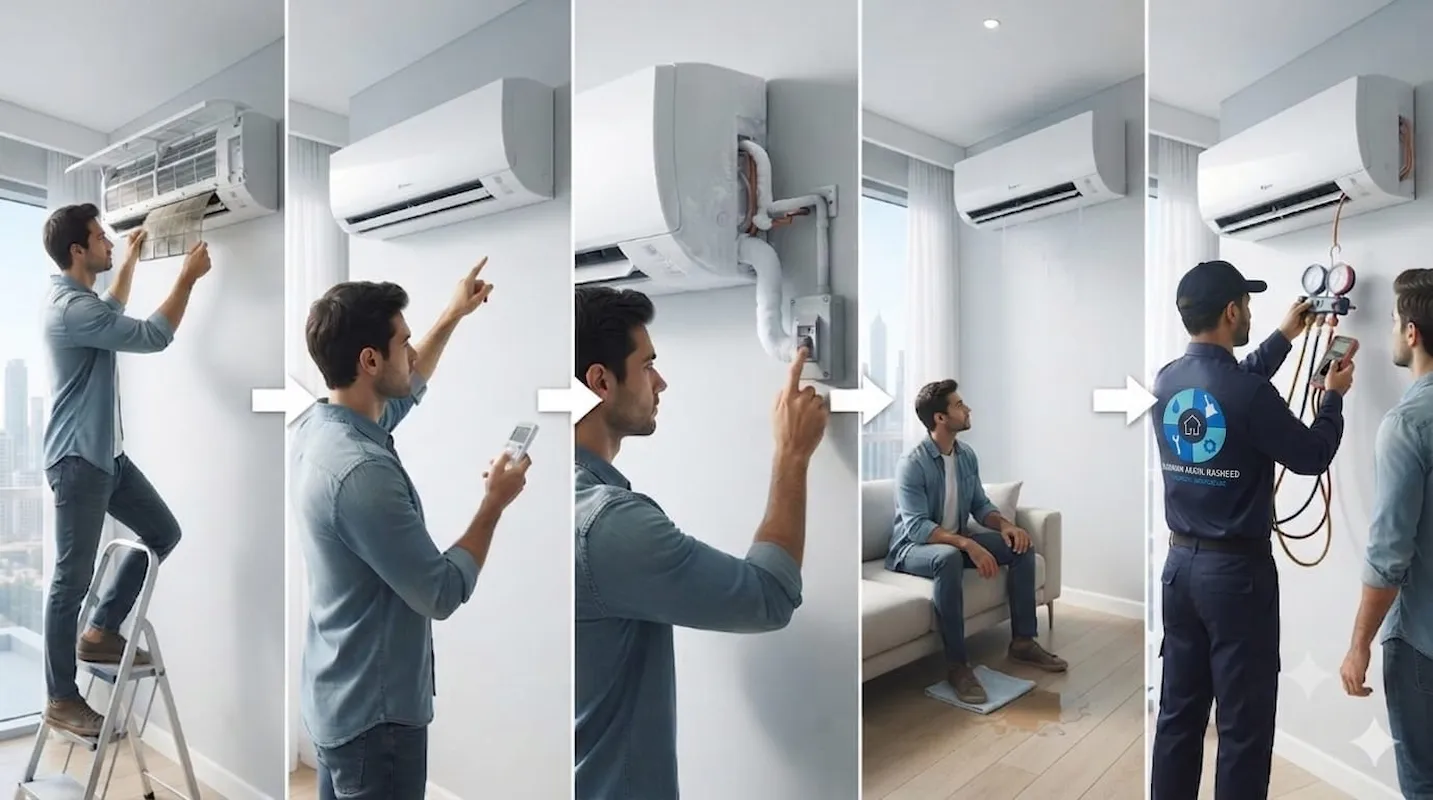
Whether you are an owner or a tenant, here is the exact sequence to follow when your AC stops cooling in Dubai:
| Step | Action | Time needed |
| 1 | Check and clean the filter. This fixes the problem in roughly 30% of cases. | 10 minutes |
| 2 | Check the thermostat: correct mode (COOL not FAN), working batteries, correct temperature set. | 2 minutes |
| 3 | Check if ice is visible on the copper pipes coming from the indoor unit. If yes, turn the AC OFF completely and let it defrost for 2 hours. | 2 hours |
| 4 | Restart the unit after filter cleaning or defrost. Give it 30 minutes to assess improvement. | 30 minutes |
| 5 | If still not cooling: turn off and call a licensed technician for a professional diagnosis. | Same day |
| 6 (tenants only) | If landlord is responsible for the repair: send a formal written repair request by email immediately, referencing Article 16. | 15 minutes |
| 7 (tenants only) | If landlord does not respond within 7 days: file a complaint with the RDC at rdc.dubai.gov.ae | 30 minutes online |